
Dark versionDefault version
Kim Lang

Kim Lang

Instructional Design Leader | Driving Learning Innovation

Screen Capture: Using Party Rock (AI) for Fundraising

Screen Capture: Using Party Rock (AI) for Fundraising

The Problem

Small nonprofits face significant challenges incorporating artificial intelligence into their fundraising efforts. Many organizations lack the technical expertise, budget, or resources to explore AI tools that could enhance their donor engagement and fundraising strategies. Without accessible, user-friendly AI solutions, these nonprofits miss opportunities to streamline their fundraising communications, personalize donor outreach, and optimize their limited resources. There’s a clear need for straightforward demonstrations that show nonprofit professionals how AI can be practically applied to their fundraising work—without requiring advanced technical skills or expensive software investments.

The Description

This five-minute screen capture video demonstrates how nonprofits can use Party Rock by AWS AI as a practical fundraising tool. Party Rock is Amazon Web Services’ no-code platform that allows users to build AI-powered applications (called “apps”) using simple, conversational prompts—no programming experience required. Users can create custom AI assistants that help with specific tasks by simply describing what they want the app to do in plain language.

The video provides a step-by-step walkthrough showing how nonprofit professionals can use Party Rock to support their fundraising activities. The screen capture format allows viewers to see exactly how to navigate the platform, create an AI application, and apply it to real-world fundraising scenarios such as drafting donor communications, generating campaign ideas, or personalizing outreach messages. This demonstration bridges the gap between AI technology and practical nonprofit application, making advanced tools accessible to organizations with limited technical resources.

Training Metrics Dashboard


The Problem

Senior leadership needed visibility into the training department’s performance and strategic value. As the organization scaled its healthcare technology solutions across 1,100+ facilities, there was a critical need to demonstrate that the Education & Training Services department could deliver high-quality learning experiences while efficiently managing resources. Leadership required data-driven evidence that training operations could scale without compromising learner satisfaction or operational efficiency.

Description

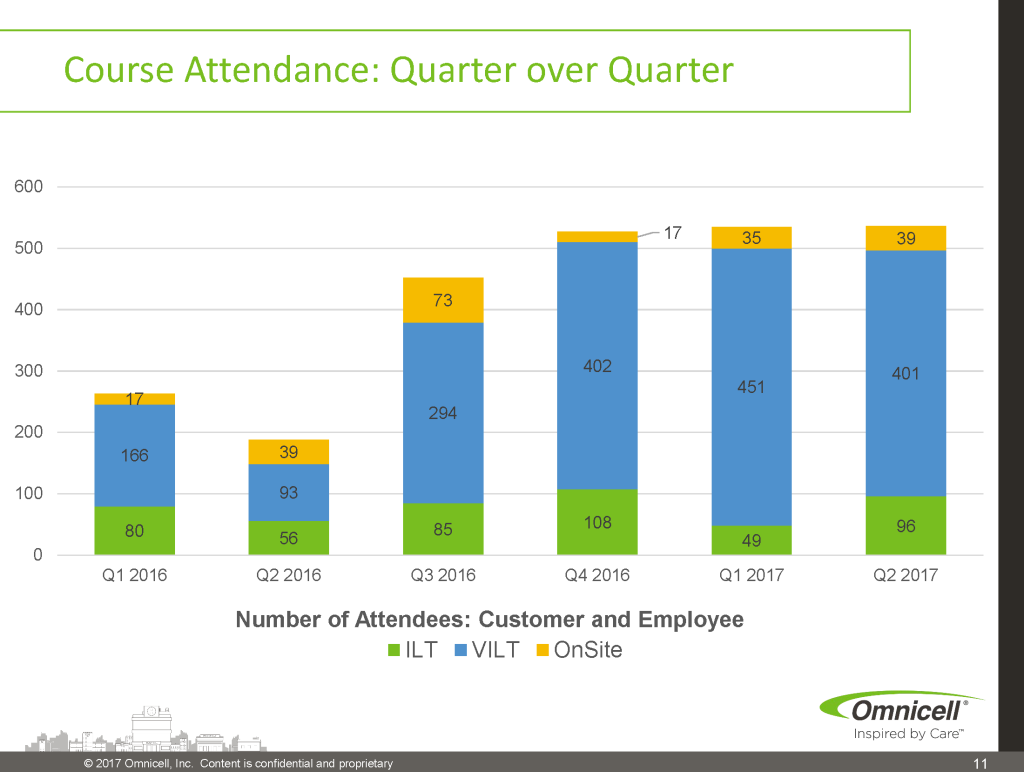
I developed and implemented a comprehensive metrics reporting system that provided quarterly snapshots of departmental performance across instructional design, eLearning delivery, and facilitation operations. This Q2 2017 dashboard showcased our ability to maintain exceptional quality at scale, with key achievements including:

Customer Satisfaction & Quality: Achieved 93% satisfaction rate (Very Satisfied and Satisfied) for eLearning modules, with learners specifically citing the visual, interactive, and easy-to-use nature of our training as top strengths.

Scale & Reach: The training department delivered 64,500 course completions to 26,000 unique learners across 1,100 facilities through our partnership with HealthStream, demonstrating significant market penetration with major healthcare systems including Ascension, Kettering Health Network, and Tenet HealthCare Corporation.

Growth in Facilitation: Attendance increased to 536 learners in Q2 2017 (up from 452 in Q1), with facilitation hours reaching 1,300 hours—a 24% increase quarter-over-quarter. This growth was achieved while maintaining the 40% facilitation goal and strategically balancing instructor time across facilitation, course development, and customer support.

Resource Optimization: The metrics demonstrated effective resource allocation, with instructional design team maintaining 79% focus on course development (exceeding the 70% goal) while supporting multiple product lines (Medication Adherence, Supply, MTS, OptiFlex, and IMS).

This transparent, data-driven approach to reporting established credibility with senior leadership and provided the foundation for strategic resource planning and investment decisions in training operations.


Training Newsletter

A newspaper with desktop items with the words Training Newsletter

The Problem

Historically, Omnicell’s Education & Training Services department struggled with visibility across multiple stakeholder groups. Despite offering comprehensive training programs including eLearning, virtual instructor-led courses, classroom workshops, and partnerships like HealthStream, customers had been unaware of the full range of services available to support their Omnicell implementations. Sales representatives had lacked marketing collateral to promote training as a value-add during contract negotiations. Internal stakeholders—including senior management—had limited insight into the training department’s strategic initiatives, new program launches, and operational achievements. This longstanding communication gap had resulted in underutilization of training resources, missed revenue opportunities, and insufficient executive awareness of departmental contributions to organizational goals. A strategic communication solution was needed to bridge these gaps and elevate the training department’s profile both internally and externally.

Description

I conceptualized, developed, and launched Training Insights, a quarterly newsletter that transformed how Omnicell communicated training services to customers and internal stakeholders. This strategic communication tool served dual purposes: educating customers about available training resources and keeping senior leadership informed about departmental innovations and market impact.

Content Strategy & Development: I led content creation for each issue, writing the majority of articles while coordinating contributions from training team members to showcase departmental expertise and highlight individual achievements. Content focused on strategic initiatives including new program launches (Subscription Training Program, virtual training availability), infrastructure investments (XT classroom upgrades, East Coast Training Center development), team spotlights (Instructional Design team capabilities), and performance metrics (HealthStream usage statistics, customer satisfaction data).

Multi-Channel Distribution: The newsletter reached diverse audiences through multiple distribution channels: customer portal access for 150+ hospital clients, internal portal distribution to Omnicell employees across departments, and direct distribution by sales representatives during customer meetings and contract negotiations. This multi-pronged approach ensured maximum visibility across the organization and customer base.

Strategic Communication Impact: Training Insights successfully addressed the core visibility challenge by keeping customers informed about new training modalities and updated course offerings that aligned with product upgrades. Sales representatives leveraged the newsletter as a tangible demonstration of Omnicell’s commitment to customer success and ongoing support. Senior management gained quarterly visibility into departmental strategic initiatives, enabling better understanding of training’s role in product commercialization, customer retention, and revenue generation.

Change Management & Marketing: The newsletter served as an effective change management tool, communicating major transitions such as classroom technology upgrades, new training center openings, and the introduction of virtual training formats. It also functioned as a marketing vehicle for new revenue-generating programs, promoting the Subscription Training Program, onsite training options, and expanded course catalogs that sales teams could position as competitive differentiators.

Internal stakeholders consistently provided positive feedback on the newsletter’s value in keeping them informed about training department activities and achievements. The publication successfully elevated the training department’s profile within the organization and reinforced Omnicell’s position as a partner invested in customer success through comprehensive learning support.

Needs Analysis Introduction

A magnifying glass on top of a report with the words Needs Analysis Introduction

The Problem

Following Omnicell’s acquisition of InPharmics in April 2017, the organization needed to rapidly commercialize the DSCSA Management Module to capitalize on an urgent market opportunity. With a critical November 2017 federal regulatory deadline approaching—requiring manufacturers to provide electronic transaction records and implement 2D barcodes—hospital pharmacies across the country desperately needed compliance solutions. However, without comprehensive training materials, Omnicell risked losing market share to competitors and failing to generate expected revenue from the newly acquired 150-hospital customer base. Leadership required a strategic assessment to determine the optimal training approach, identify implementation risks, and establish a clear development roadmap that would enable successful product launch while meeting the compressed regulatory timeline.

Description

I led a comprehensive needs analysis to evaluate training requirements for Omnicell’s newly acquired DSCSA Management Module, a critical compliance tool for hospital pharmacies navigating complex federal drug supply chain regulations. This strategic assessment directly supported revenue generation by enabling the commercialization of the InPharmics acquisition.
The analysis addressed multiple stakeholder needs across product management, marketing, and customer success teams. I conducted stakeholder interviews with subject matter experts, evaluated existing training resources, and assessed the technical learning requirements for Directors of Pharmacy (DOPs) who would be primary users of the module.

Key deliverables included:

Strategic Recommendations: Developed a multi-modal training strategy featuring Adobe Captivate simulations and online modules, optimizing for both customer accessibility and scalability across 150+ hospitals.
Risk Assessment: Identified critical project risks including staffing constraints, release timeline pressures, and technical dependencies. Proactively flagged the impact of instructional designer vacancy and interface branding updates on project delivery.

Resource Planning: Established development requirements, timelines (4-week delivery with 100-hour estimate), and cross-functional dependencies to ensure successful execution.

Stakeholder Alignment: Documented open questions regarding long-term customer support, workflow integration with InPharma services, and module access protocols to facilitate executive decision-making.

This needs analysis provided leadership with the data-driven insights necessary to make informed investment decisions and successfully launch DSCSA training ahead of the November 2017 regulatory deadline. The resulting training modules supported customer compliance and contributed to revenue generation from the InPharmics product line.

Development of the Subscription Training Program

Hands holding globe with the words Subscription Training Program

The Problem

Omnicell faced a competitive disadvantage in the healthcare technology training market. Customers—particularly hospital directors of pharmacy and pharmacy techs—required ongoing, flexible access to training as new employees joined, software updates rolled out, and regulatory requirements evolved. However, the traditional pay-per-course model created budget barriers that limited training participation and left system administrators and super users inadequately prepared to support their facilities. Additionally, the sales team lacked differentiated training offerings to compete effectively against rivals. The organization needed an innovative training business model that would generate predictable recurring revenue, provide unlimited value to customers, and give sales a competitive edge in contract negotiations.

Description

I designed and launched Omnicell’s first subscription-based training program, creating a new revenue stream while solving critical customer pain points around training accessibility and cost predictability. This program represented a fundamental shift in the company’s training business model and became a key competitive differentiator that sales teams leveraged to win contracts.

Program Design & Strategy: The subscription model provided unlimited training access tailored to different user roles within healthcare facilities. Pharmacists and system administrators received unlimited instructor-led training (ILT) and virtual instructor-led training (VILT) sessions across multiple product lines including Central Pharmacy Manager, Controlled Substance Manager, and Point of Use systems. Nursing staff gained unlimited access to eLearning modules through the organization’s partnership with HealthStream, ensuring frontline clinical staff could access just-in-time training.

Cross-Functional Leadership: I collaborated with Operations and Sales leadership to secure approval for program development, build internal buy-in, and establish pricing models that balanced customer value with revenue goals. This required presenting business cases, addressing operational concerns, and aligning stakeholders across multiple departments on the strategic benefits of recurring revenue.

Market Impact: The subscription model quickly became the preferred purchasing option, with the majority of facilities choosing subscriptions over traditional à la carte training after the program launched. Sales teams successfully positioned the unlimited training access as a compelling value proposition that differentiated Omnicell from competitors, directly contributing to contract wins and customer retention.

Product Features:

  • Flexible delivery modalities (VILT and eLearning) optimized for different learner needs
  • Comprehensive course catalog covering pre-installation basics through advanced system optimization
  • Scalable model supporting multiple users per facility without additional per-seat costs
  • Registration system enabling any system administrator or super user to access training with facility subscription number

This innovative program demonstrated my ability to identify market opportunities, develop new business models, secure cross-functional support, and create scalable solutions that drive both customer satisfaction and organizational revenue growth.