Dark versionDefault version
Kim Lang

Kim Lang

Instructional Design Leader | Driving Learning Innovation

Integrating AI in the ADDIE Model

A lightbulb representing AI that reads Integrating AI in the ADDIE Model

The Problem

Instructional designers struggle to integrate AI tools efficiently into their traditional ADDIE workflow, unsure of which tools to use at each phase and how much time they can realistically save.

Description

This guide maps AI tools and applications to each phase of the ADDIE model (Analysis, Design, Development, Implementation, and Evaluation). It provides specific tool recommendations, time savings data showing 50-90% efficiency gains, and decision frameworks for when to use AI versus traditional methods. The document includes detailed tables comparing traditional timelines with AI-assisted timelines for every major instructional design task.

Integrating AI in SAM

A lightbulb representing AI that reads Integrating AI in SAM

The Problem

Instructional designers need faster, more agile project delivery but don’t know how to leverage AI to accelerate SAM’s iterative cycles without sacrificing quality.

Description

This guide demonstrates how AI transforms the three-phase SAM model (Preparation, Iterative Design, Iterative Development) from a weeks-long process into a days-long workflow. It shows how to create working prototypes in 1-2 hours using tools like Articulate AI.  The document provides side-by-side comparisons of SAM versus ADDIE with AI integration and recommends when to use each approach.

Ethical Use of AI in Instructional Design

A lightbulb representing AI that reads Ethical Use of AI in Instructional Design

The Problem

Instructional designers using AI may lack clear ethical frameworks, risking accuracy errors, bias perpetuation, privacy violations, and copyright infringement that could harm learners and create legal liability.

Description

This principles-based framework establishes five core ethical pillars for responsible AI use: Transparency, Accuracy, Bias Mitigation, Privacy, and Intellectual Property protection. Each principle includes practical “Poor Practice vs. Best Practice” scenario comparisons showing real-world applications, plus implementation guidelines and a comprehensive 15-point ethics checklist. The document is grounded in 2024 U.S. Department of Education guidelines on algorithmic discrimination and provides actionable steps for building ethics into your AI workflow.

Screen Capture: Using Party Rock (AI) for Fundraising

Screen Capture: Using Party Rock (AI) for Fundraising

The Problem

Small nonprofits face significant challenges incorporating artificial intelligence into their fundraising efforts. Many organizations lack the technical expertise, budget, or resources to explore AI tools that could enhance their donor engagement and fundraising strategies. Without accessible, user-friendly AI solutions, these nonprofits miss opportunities to streamline their fundraising communications, personalize donor outreach, and optimize their limited resources. There’s a clear need for straightforward demonstrations that show nonprofit professionals how AI can be practically applied to their fundraising work—without requiring advanced technical skills or expensive software investments.

The Description

This five-minute screen capture video demonstrates how nonprofits can use Party Rock by AWS AI as a practical fundraising tool. Party Rock is Amazon Web Services’ no-code platform that allows users to build AI-powered applications (called “apps”) using simple, conversational prompts—no programming experience required. Users can create custom AI assistants that help with specific tasks by simply describing what they want the app to do in plain language.

The video provides a step-by-step walkthrough showing how nonprofit professionals can use Party Rock to support their fundraising activities. The screen capture format allows viewers to see exactly how to navigate the platform, create an AI application, and apply it to real-world fundraising scenarios such as drafting donor communications, generating campaign ideas, or personalizing outreach messages. This demonstration bridges the gap between AI technology and practical nonprofit application, making advanced tools accessible to organizations with limited technical resources.

Training Metrics Dashboard


The Problem

Senior leadership needed visibility into the training department’s performance and strategic value. As the organization scaled its healthcare technology solutions across 1,100+ facilities, there was a critical need to demonstrate that the Education & Training Services department could deliver high-quality learning experiences while efficiently managing resources. Leadership required data-driven evidence that training operations could scale without compromising learner satisfaction or operational efficiency.

Description

I developed and implemented a comprehensive metrics reporting system that provided quarterly snapshots of departmental performance across instructional design, eLearning delivery, and facilitation operations. This Q2 2017 dashboard showcased our ability to maintain exceptional quality at scale, with key achievements including:

Customer Satisfaction & Quality: Achieved 93% satisfaction rate (Very Satisfied and Satisfied) for eLearning modules, with learners specifically citing the visual, interactive, and easy-to-use nature of our training as top strengths.

Scale & Reach: The training department delivered 64,500 course completions to 26,000 unique learners across 1,100 facilities through our partnership with HealthStream, demonstrating significant market penetration with major healthcare systems including Ascension, Kettering Health Network, and Tenet HealthCare Corporation.

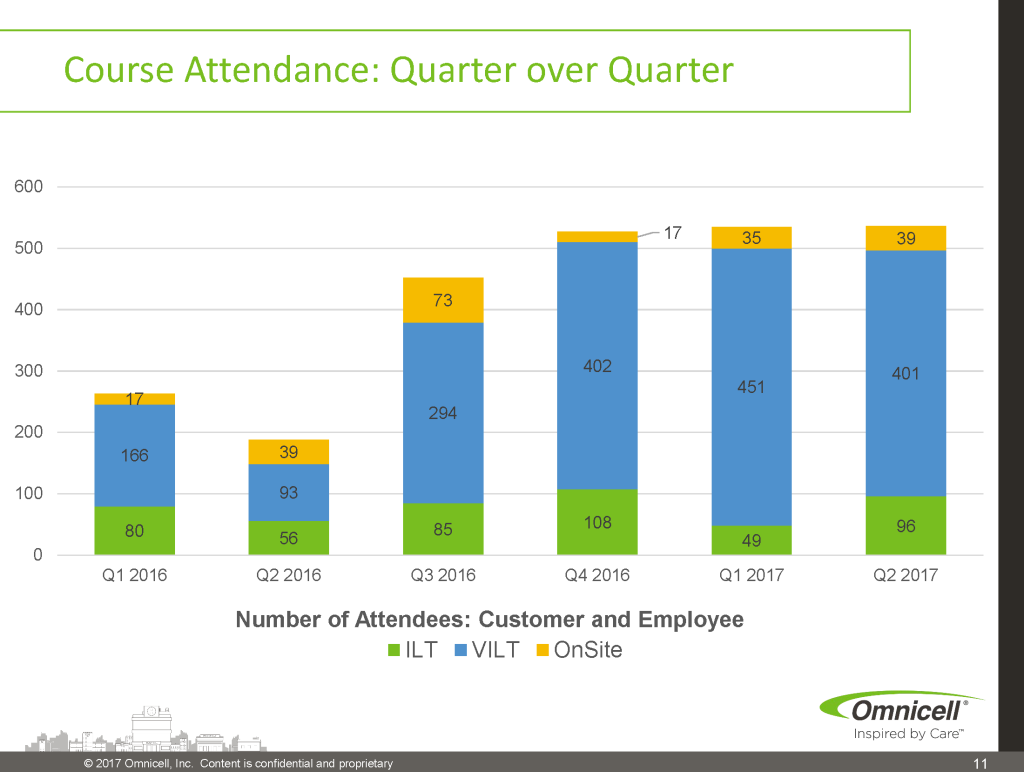
Growth in Facilitation: Attendance increased to 536 learners in Q2 2017 (up from 452 in Q1), with facilitation hours reaching 1,300 hours—a 24% increase quarter-over-quarter. This growth was achieved while maintaining the 40% facilitation goal and strategically balancing instructor time across facilitation, course development, and customer support.

Resource Optimization: The metrics demonstrated effective resource allocation, with instructional design team maintaining 79% focus on course development (exceeding the 70% goal) while supporting multiple product lines (Medication Adherence, Supply, MTS, OptiFlex, and IMS).

This transparent, data-driven approach to reporting established credibility with senior leadership and provided the foundation for strategic resource planning and investment decisions in training operations.